THE
ASTORIA COLUMN
by Jackie Meredith
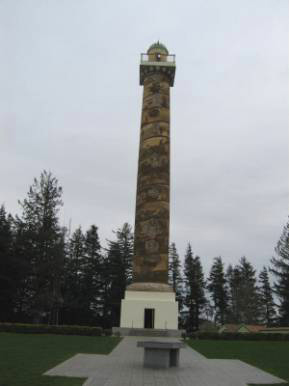 The
Astoria Column is the last of a series of 12 historical markers erected in the early 1900’s between St. Paul, Minnesota and Astoria,
Oregon. These markers were the pet project of Ralph Budd, president of the
Midwest-based Great Northern Railroad. In 1925, he announced that he and other
businessmen and scholars wanted to “properly salute Astoria’s explorers and
early settlers for their critical role in the United States’ stretch to the
Pacific Coast.”
The
Astoria Column is the last of a series of 12 historical markers erected in the early 1900’s between St. Paul, Minnesota and Astoria,
Oregon. These markers were the pet project of Ralph Budd, president of the
Midwest-based Great Northern Railroad. In 1925, he announced that he and other
businessmen and scholars wanted to “properly salute Astoria’s explorers and
early settlers for their critical role in the United States’ stretch to the
Pacific Coast.”
LOCATION
Towering
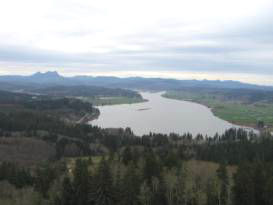
above Astoria, the column on Coxcomb Hill offers a panoramic view of the ocean,
rivers, and mountains.
MAIN
CHARACTERS
Great
Northern Railroad and philanthropist, Vincent Astor, great-grandson of John
Jacob Astor for whom Astoria is named, funded the cost of the Column and the
site’s 30 acres atop Coxcomb Hill. The City of Astoria prepared the land and
access road. The architect was a New Yorker, Electus Litchfield, who patterned
it after the Trajan Column in Rome, Italy. The construction contract was awarded
to AB Guthrie and Co., of Portland. The group retained an Italian immigrant
artist, Attilo Pusterla to create a bas-relief technique Italian Renaissance art
form called sgraffito combining paint
and plaster carvings to decorate the exterior with a frieze of 14 significant
events that occurred in the region.
THE
DREAM UNFOLDS INTO REALITY
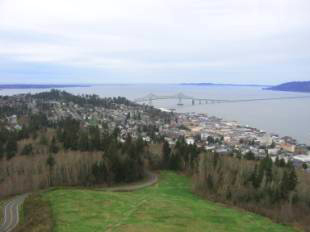 Construction began in March 1926 atop an elevation of Coxcomb Hill’s
600-feet offering its expansive views surrounding Astoria, the Columbia River,
Pacific Ocean, and coastal area. By May, exterior decoration began. Whereupon
only three of the bands were completed by dedication day on July 22, Pusterla
and his assistants finished their work on October 29, 1926.
Construction began in March 1926 atop an elevation of Coxcomb Hill’s
600-feet offering its expansive views surrounding Astoria, the Columbia River,
Pacific Ocean, and coastal area. By May, exterior decoration began. Whereupon
only three of the bands were completed by dedication day on July 22, Pusterla
and his assistants finished their work on October 29, 1926.
Constructed
of concrete with a foundation of 12 feet deep, the height is 125 feet with an
interior 164 steps on a circular staircase surrounded by 500 feet of banded
murals leading to a viewing platform. Oregon’s state seal is displayed at top.
The column was dedicated July 22, 1926 and original costs were $27,133.96.
The Astoria Column was
originally designed to replicate the 100-foot-tall marble Trajan Column erected
in Rome around 114 A.D. by Emperor Trajan. The Roman column is covered by a
continuous low-relief sculpture depicting Trajan's Dacian campaigns. The
University of Kentucky King Library Press Website (2007) offers more detailed
information:
"... Trajan's Column was erected 106-113 C.E.
in Trajan's Forum in Rome to commemorate his victories
over Dacia. The 100 foot tall column is made of marble quarried near
Cararra and is covered by a continuous
low-relief sculpture depicting Trajan's Dacian campaigns. The column and capital
were
constructed from 20 separate blocks of marble and the column contains a
spiral stair leading to an observation
platform at the top. The pedestal supporting the column is about 25 feet tall
and served as Trajan's tomb after his death in 117. Originally the column was
topped by a bronze eagle, but that was replaced
by a statue of Trajan after his death. The statue of Trajan, now lost, was
replaced by a statue of
Saint Peter in 1588. The inscription over the door in the pedestal has long been
regarded as one of
the finest examples of Roman letter forms and has been the basis for many
type faces. ..."
The Astoria Column is an
artful summary of the triumphs, conflicts, and turning points of the frontier
– pieces of American Indian, U.S. and Oregon history.
Descriptions
of the scenes are listed in reverse order, as they appear on the column from top
to bottom. (The Tonquin is a ship.)
14) Coming of the white settler and the railroad.
13) Fort Astoria returned to the United States, 1818.
12) Fort Astoria sold to the British and renamed Fort George, 1815.
11) The Tonquin, the Pacific Fur Company ship, blown up at Vancouver
Island, 1811.
10) Pacific Fur Company Overland Party arrives at Astoria, 1812.
9) The Tonquin arrives at Astoria, 1811. Building of Fort Astoria.
8) The Tonquin, the ship belonging to John Jacob Astor's Pacific Fur
Company, sails from New York, 1810.
7)
Lewis & Clark Expedition builds Fort Clatsop.
6) Lewis & Clark Expedition spends the winter of 1805-1806 on the
Lewis & Clark River near Astoria.
5) Lewis & Clark Expedition boiling sea water to make salt.
4) Lewis & Clark Expedition, first to cross the continent, arrives
at Astoria, 1805.
3) Native American village on land now known as Astoria.
2) Discovery of the Columbia River by Captain Robert Gray in the ship
Columbia, 1792.
1) Native Wilderness.
Within three years after completion, the coast’s
weather had already taken a toll on the mural. While Pusterla’s technique
fared well in Mediterranean climates, the Pacific Northwest storms ravaged and
threatened the carvings and pigments, and the salty winds off the Pacific Ocean
began dimming and threatening the carvings.
The arrival of the Great Depression in October 1929
crushed fund-raising efforts. Once again, the Astor family contributed the
majority of the $5,000 cost needed to stabilize the mural, and in 1936, Pusterla
returned to Astoria to make repairs and waterproof the mural.
During World War II, the site was closed and a blimp
squadron for coastal reconnaissance moved onto Coxcomb Hill. In 1947, the Column
reopened to the public.
THE
COLUMN TODAY
 In
1974, the Column was listed in the National Register for Historic Places. In
1995, the Column underwent a $1 million painstaking restoration, and in 2004,
received a new granite plaza and ADA accessible walkway for an additional
restoration cost of $1.7/1.5 million. More than 300,000/400,000 visitors
annually visit the site. Stop by the parking lot’s gift shop and join in the
tradition of purchasing a balsawood plane, climb to the top, and launching them
in the air.
In
1974, the Column was listed in the National Register for Historic Places. In
1995, the Column underwent a $1 million painstaking restoration, and in 2004,
received a new granite plaza and ADA accessible walkway for an additional
restoration cost of $1.7/1.5 million. More than 300,000/400,000 visitors
annually visit the site. Stop by the parking lot’s gift shop and join in the
tradition of purchasing a balsawood plane, climb to the top, and launching them
in the air.
Open year-round from dawn until dusk, a $1.00 charge for
parking is based on the honor system and visitors pay the fee at the gift shop.
The gift shop is open from 10:00 am – 4:00 pm Monday through Friday and 9:00
am to 5:00 pm on weekends. During the summer, hours are 9:00 am – 6:00 pm
daily.
FOR
FURTHER INFORMATION
Friends of Astoria Column, Inc.
PO Box 717
Astoria, Oregon 97103
503.325.2963
REFERENCE
LISTINGS
Friends of Astoria Column, Inc. 2003 brochure
BUSINESS WIRE, June 10, 2004
http://www.oregoncoast.com/Astorcol/Astorcol.htm
http://www.infinityinternet.com/~englishriver/LewisClarkColumbiaRiver/Regions/Places/astoria_column.html
http://www.oregon.com/rips/Astoria_column.cfm
DRIVING
DIRECTIONS
Follow Highway 30 heading east, turn south on 16th
Street and follow the signs up to the Column.